Ecommerce Website vs Marketplace (Amazon/Flipkart): What's Better for Your Shop?
Own ecommerce website vs Amazon or Flipkart — compare commissions, customer data, margins, and control to decide the best way for your shop to sell online in India.
Ecommerce Website vs Marketplace (Amazon/Flipkart): What's Better for Your Shop?
If you run a shop and want to sell online in India, you have two main roads: list your products on a marketplace like Amazon or Flipkart, or build your own ecommerce website. Owners ask us this all the time, and the honest answer to the own ecommerce website vs Amazon question is: it depends on your margins, your products, and how long-term you are thinking. This guide compares both options in plain language so you can decide what is right for your business — without any technical jargon.
How Marketplaces Like Amazon and Flipkart Actually Work
A marketplace is a huge online mall. You rent a small shelf inside it. Millions of buyers already visit every day, which is the big attraction — you can start getting orders within days of listing, without spending anything on marketing. But that shelf comes with rules and rent:
- Commission on every sale: Marketplaces typically take roughly 5% to 30% of each order depending on the category, plus fixed closing fees and shipping charges. On low-margin products, the marketplace can earn more from a sale than you do.
- You compete on the same page: Your product listing sits next to ten similar products, often sorted by price. The buyer compares you against everyone, and the cheapest seller usually wins.
- The customer belongs to the marketplace: You do not get the buyer's phone number or email. You cannot message them about a new product or a festival offer. Next time they buy, they search the marketplace — not your shop.
- Rules can change overnight: Commission rates, listing policies, payment cycles, even account suspensions — all decided by the platform, not by you.
Own Ecommerce Website vs Amazon: The Real Differences
Now the other road. An ecommerce website for small business is your own shop on the internet — your brand name on the door, your rules inside. Here is how the two compare on the things that actually affect your profit.
1. Commissions and margins
On your own website, there is no commission per sale. You pay a small payment gateway fee (around 2% for UPI/cards) and that is it. If you sell ₹1,00,000 of products in a month, a marketplace might keep ₹15,000–₹25,000 of it in fees. On your own site, almost all of that stays with you. Over a year, that difference alone can pay for the website many times over.
2. Customer data and repeat sales
This is the difference most owners underestimate. On your own website, every order gives you the customer's name, phone number, and address. You can send them a WhatsApp message when new stock arrives, offer a Diwali discount, or simply thank them. Repeat customers are the cheapest customers you will ever get — and marketplaces keep them for themselves. Pair your store with WhatsApp automation and repeat orders can run almost on autopilot.
3. Branding and trust
On Amazon, the buyer remembers Amazon, not you. On your own website, they remember your shop's name, see your story, your photos, your reviews. That brand value compounds year after year — it is an asset you own, like your physical shop.
4. Traffic: the marketplace's real advantage
To be fair, marketplaces win on day-one traffic. Your own website starts with zero visitors, and you have to earn them through Google. The good news: with proper SEO and Google ranking work, a local shop's website can start appearing for searches like "buy [your product] online" or "[your product] in [your city]" within a few months — and that traffic is free and permanent, unlike ads.
5. Control over pricing and offers
Marketplaces often pressure sellers into discounts and sale events. On your own site, you set the price, bundle products your way, and run offers when it suits your business — not the platform's sale calendar.
What Does an Ecommerce Website for Small Business Cost in India?
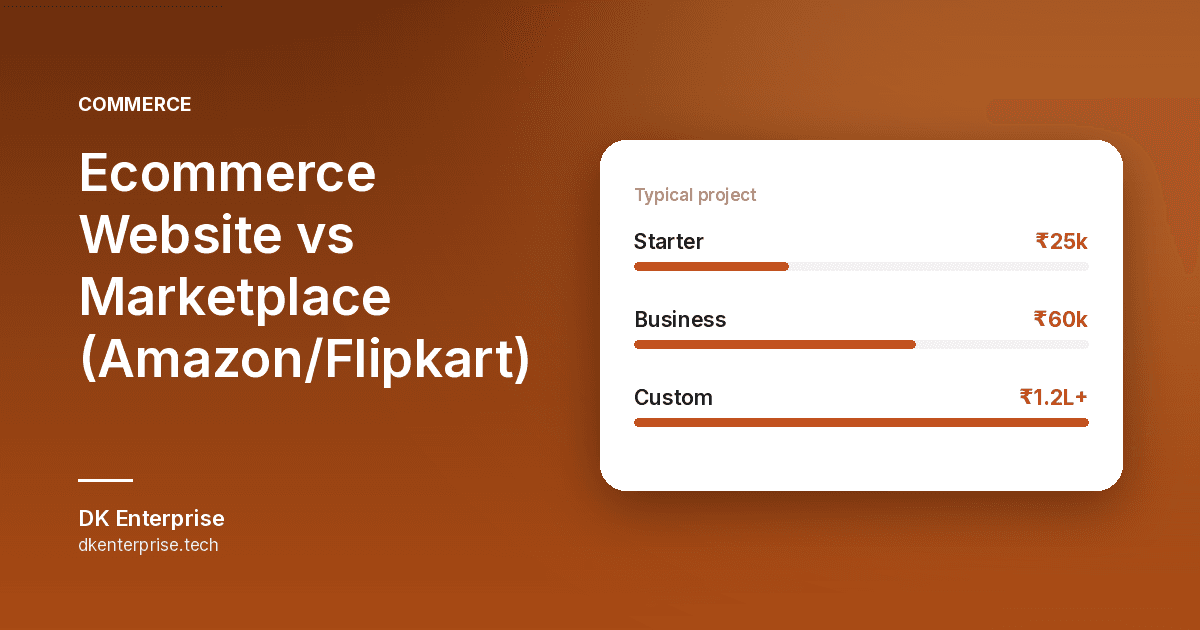
Less than most owners expect. A clean, fast ecommerce website with product listings, cart, UPI/card payments, and an easy admin panel typically costs around ₹25,000–₹60,000 as a one-time build for a small business, plus small yearly costs for domain and hosting (roughly ₹3,000–₹6,000 per year). Compare that with paying 15–25% commission on every single order, forever. For many shops, the website pays for itself within a few months of steady orders. See our website development services for what is included, or the ecommerce development page if you are in North Gujarat.
So Which Should You Choose? A Simple Decision Guide
Here is the honest, non-salesy answer:
- Choose a marketplace if you sell standard, price-driven products (electronics accessories, generic goods), want orders from all over India immediately, and are okay with thin margins.
- Choose your own ecommerce website if you have a brand or unique products (handmade items, food, clothing, local specialities), care about repeat customers, or your margins cannot survive 20% commissions.
- The smartest approach for most shops: do both. Use the marketplace as one sales channel for discovery, and your own website as home base — where margins are better, customers are yours, and the brand grows. Many successful Indian sellers start on a marketplace and move their loyal customers to their own site over time.
Whichever you choose, connect your orders, stock, and customer follow-ups with simple business automation so growth does not mean more manual work.
Mistakes to Avoid When You Start Selling Online
Depending on one channel only
Sellers who built everything on a single marketplace account have lost their whole business to one suspension email. Your own website is insurance — a channel nobody can switch off.
Ignoring your existing customers
Your regular walk-in customers are your easiest first online buyers. Print your website on the bill, share it in your WhatsApp status, and let them order from home. That is early traffic that costs nothing.
Building a slow, complicated website
A slow site loses buyers before they see your products. Keep it fast, mobile-first, and simple to order from — most of your customers will shop on their phones.
FAQ
Can I sell on Amazon/Flipkart and have my own website at the same time?
Yes, and it is usually the best strategy. Use marketplaces for reach and your own website for better margins and repeat customers. Your stock and pricing can be managed for both together.
How much commission do Amazon and Flipkart charge sellers in India?
It varies by category, but between referral fees, closing fees, and shipping, sellers commonly part with 15–30% of the order value. On your own website you pay only a payment gateway fee of around 2%.
Will anyone find my own ecommerce website without ads?
Yes — with proper SEO, product pages can rank on Google for searches related to your products and city. It takes a few months to build, but the traffic is free and long-lasting, and you can share your link on WhatsApp and social media from day one.
Ready to Sell Online on Your Own Terms?
DK Enterprise builds fast, affordable ecommerce websites for small businesses across Gujarat and India — with UPI payments, an easy admin panel, and SEO done right from day one. Contact us for a free consultation and we will tell you honestly whether a marketplace, your own website, or both is the right move for your shop.
Written by DK Enterprise
Published on 13 July 2026