Mobile App vs Mobile Website: Which Does Your Business Actually Need?
Mobile app vs website — an honest comparison for Indian business owners, with costs in ₹, a simple decision guide, and how to know if you really need an app.
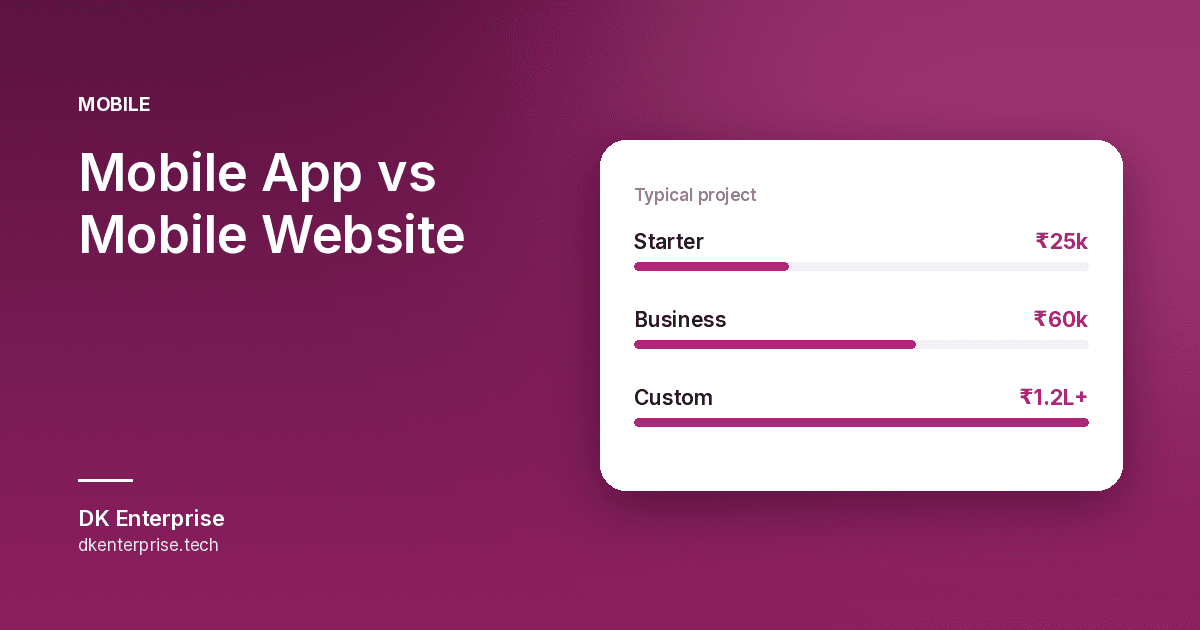
Mobile App vs Mobile Website: Which Does Your Business Actually Need?
Almost every week, a business owner tells us the same thing: "I want an app for my business." When we ask why, the answer is usually "everyone has one" or "my competitor made one." Both are real feelings, but neither is a business reason. The honest truth about mobile app vs website is that most small and medium businesses in India get far more customers, far faster, from a good mobile website — and an app only starts paying for itself once you have people coming back again and again. This post explains the difference in plain language, gives realistic costs in ₹, and ends with a simple decision guide so you can answer "does my business need an app" for yourself.
First, What Is Actually Different?
People use the words loosely, so let us be precise.
A mobile website
This is your normal website, built so it works properly on a phone screen. Someone finds it on Google, taps the link, and it opens instantly in Chrome. Nothing to install. You update it whenever you like and everybody sees the change immediately.
A mobile app
This is a program the customer downloads from the Play Store or App Store and installs on their phone. It sits on their home screen with your icon. It can send push notifications, work partly offline, and use the phone's camera, GPS and fingerprint sensor more deeply.
And the middle option: a PWA
A Progressive Web App is a website that a customer can "Add to Home Screen." It gets an icon, opens full screen without the browser bar, and can work offline for some content. It is not as powerful as a real app, but it costs a fraction of one and needs no Play Store approval. For a lot of businesses this is the sensible middle step, and it is something we usually build into a custom website project rather than charging for separately.
The Biggest Difference Nobody Mentions: Being Found
This is the point that decides it for most businesses.
A website is found by strangers. Someone in your city searches "furniture shop near me" or "CBSE school admission Palanpur", and your page can appear in Google results. That person had never heard of you before. Every day, new people discover you at zero extra cost. That is why SEO and Google ranking work pays off for years.
An app is found by people who already know you. Nobody browses the Play Store hoping to discover a local business. To get an app installed, you first have to convince someone — through your website, your shop, your WhatsApp, or paid ads — and then convince them again to spend data and phone storage installing it. Getting a single genuine install through advertising in India commonly costs anywhere from ₹40 to ₹200 or more, and a large share of installs are opened once and never again.
So if your goal is new customers, a website wins. If your goal is keeping existing customers coming back, an app becomes interesting.
What Does It Cost in India?
Ballpark figures for professionally built work in India, so you can plan:
- Mobile-friendly business website — roughly ₹15,000–₹60,000 one time, plus about ₹3,000–₹8,000 a year for domain and hosting.
- Ecommerce website with payments and order management — roughly ₹40,000–₹1,50,000 depending on catalogue size and features.
- Cross-platform mobile app (one codebase for Android and iOS) — commonly ₹1,00,000–₹5,00,000+ depending on features, plus ongoing maintenance.
The number people forget is the ongoing one. An app is never finished. Android and iOS release major updates every year, libraries break, the stores change their rules, and every fix has to be re-submitted and re-approved. Budget realistically for 15–25% of the build cost per year just to keep an app working. A website needs updates too, but a broken website is fixed in an hour, not in a three-day review queue. Our full mobile app development quotes always separate build cost from yearly upkeep for exactly this reason.
Mobile App vs Website: Side by Side
Where the website wins
- Found by new customers through Google search
- Works on every phone, laptop and tablet from one build
- No download, no storage, no app store approval
- Cheaper to build and much cheaper to maintain
- Changes go live instantly
- Easy to share — a link works in WhatsApp, on a visiting card, on a hoarding
Where the app wins
- Push notifications straight to the home screen (a website cannot do this reliably on iPhones)
- Your icon sits on the customer's phone as a permanent reminder
- Faster, smoother experience for heavy repeat use
- Better offline behaviour and deeper access to camera, GPS and biometrics
- Feels more premium for loyalty programmes, wallets and memberships
Does My Business Need an App? A Simple Decision Guide
Answer these honestly.
Start with a mobile website if…
You need people to find you. Customers deal with you occasionally — a few times a year rather than a few times a week. Your main goal is enquiries, calls, bookings or a first order. You are a shop, a school, a clinic, a builder, a factory, a consultant, a service provider, or a new brand. This describes the large majority of businesses we work with, and the right move is a fast, well-structured website — with online selling built in if you need it, as in our ecommerce development projects.
Consider an app when…
Your customers already interact with you weekly or daily and would genuinely open an icon. You have an active customer base — a rough rule of thumb is a few thousand regular customers — and repeat purchases matter more than new ones. You need something a browser cannot do well: reliable notifications, offline use in poor network areas, driver or delivery tracking, staff attendance, or a field team collecting data. Internal apps for your own staff are often a much stronger case than customer apps, because usage is guaranteed.
The order that works
Website first. Grow the audience. Watch how people behave. Build the app when the demand is visible in your own numbers, and fund it out of the revenue the website generated. Building the app first — before anyone knows you exist — is the single most expensive mistake we see.
The Option Most Businesses Overlook
Before spending lakhs on an app, ask what you actually wanted the app to do. Very often the real goal is: send customers updates, take orders, answer common questions, and stay on their phone. On Indian phones, WhatsApp already does all of that — and it is already installed. A WhatsApp AI chatbot and automation setup can send order updates, answer enquiries day and night, collect bookings and follow up on payments for a small fraction of an app's cost, with no download required. Pair that with a fast website and automated back-office workflows, and many businesses find they never needed the app at all.
If You Do Build an App, Build It Cross-Platform
Building separately for Android and iOS means two codebases, two teams and two sets of bugs. Cross-platform frameworks like React Native and Flutter let one codebase serve both, typically cutting cost and timeline substantially while performing well for the kind of app a normal business needs. Unless you are building something graphically heavy, cross-platform is the sensible default — and it is how we build for our clients.
FAQ
Is a mobile app better than a website for a small business?
Usually not, at least not first. A website brings new customers in from Google search, costs far less to build and maintain, and needs no download. An app is better once you have a base of regular customers who interact with you often and you need push notifications or offline use. Most small businesses get more return from a good website plus WhatsApp automation.
How much does app development cost in India?
A professionally built cross-platform app for a business typically starts around ₹1,00,000 and rises to ₹5,00,000 or more depending on features like payments, live tracking, chat or multiple user roles. Add 15–25% of that per year for maintenance, store compliance and OS updates. A mobile-friendly website usually costs ₹15,000–₹60,000 with only a few thousand rupees of yearly hosting.
Can my website work like an app?
To a large extent, yes. A Progressive Web App can be added to the home screen with your icon, open full screen without the browser bar, and cache content for offline viewing. The main limitation is push notifications, which are less reliable on iPhones than in a real app. For many businesses a PWA delivers most of the app experience at a small share of the cost.
Not Sure Which One You Need?
We would rather tell you honestly that you do not need an app than sell you one you will regret. DK Enterprise builds websites, ecommerce stores, cross-platform apps and AI automation for businesses across Gujarat and India — and we start by asking what you are actually trying to achieve. Contact us for a free consultation and we will tell you straight which option fits your business and your budget.
Written by DK Enterprise
Published on 27 July 2026